
Native bees: invisibles guardians of the Amazon

The native birds are the essential pollinisatrices of the Amazonian forest and local cultures, but the diversity and distribution are not fully understood.

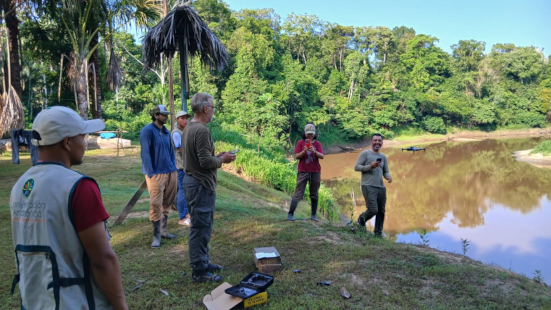
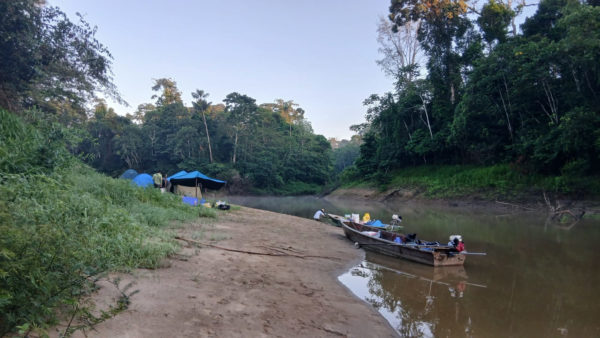
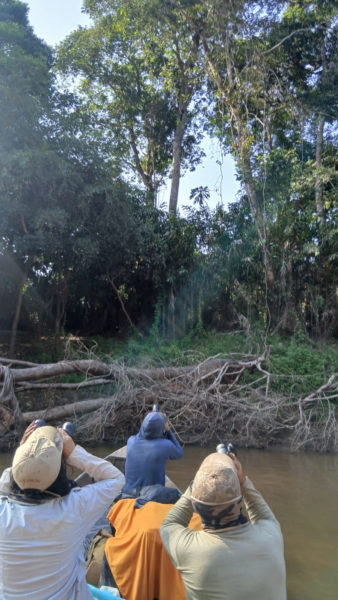
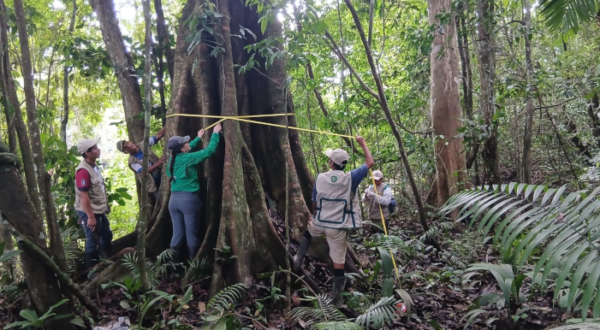
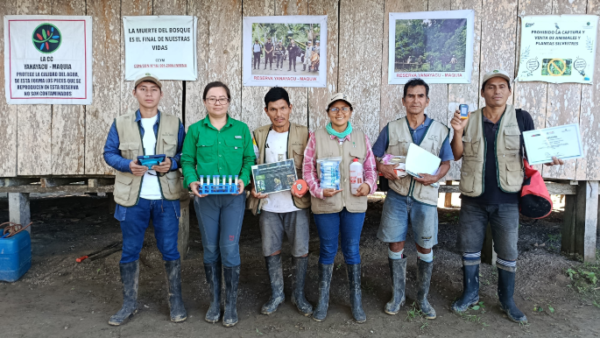
As part of a collaboration with Amazon Research International (ARI), the Yanayacu-Maquía Conservation Concession (CCYM) will participate in the first native bee mapping program in Peru, which combines indigenous knowledge with scientific research.

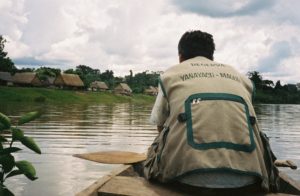
In July, an ARI team will study 40 stingless bee nests already located by CCYM forest rangers, who will also receive training in scientific monitoring protocols.

The data collected will contribute to research on the effects of climate change, the relationships between bees and the trees they inhabit, and to the creation of a research corridor dedicated to native bees.

According to Rosa Vásquez Espinoza, biologist, chemist and director of ARI, the high concentration of nests observed in a restricted area of ​​Yanayacu-Maquía confirms the exceptional importance of this concession for the conservation and study of native Amazonian bees.

June 2021

Lotty Morey with the French Ambassador to Peru and the Peruvian Minister of the Environment

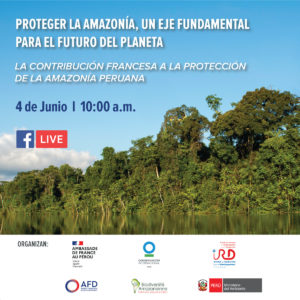
On 4 June, Lotty Morey, President of Amazon Biodiversity, spoke at a conference on France’s contribution to protecting the Amazon. Alongside the French Ambassador to Peru and the Peruvian Minister of the Environment, the President of the association recalled the association’s missions and their importance in protecting the Amazon and supporting local communities.

She was able to highlight the three main areas of work of Amazon Biodiversity: conservation, scientific research and development of economic alternatives. This intervention should allow the association to be identified by major actors in the environmental protection sector, and to develop new projects and partnerships!

Watch the conference again

May 2021

Successful outreach to communities in the concession!

This month, Charlene, Lotty and Steffanny (Envol Vert’s forestry engineer) went to the Conservation Concession to carry out outreach workshops with the different communities in the area. The workshops focused on the status and importance of the Yanayacu Maquia Conservation Concession and the services it provides to the environment and biodiversity.

Despite uneven participation rates in different communities, the workshops were generally successful. People seemed interested and involved in the project. Children and women in particular made themselves available for these collective sessions.

In addition, we were able to present the upcoming agroforestry and crop diversification projects that Biodiversité Amazonienne and Envol Vert intend to implement. The projects seemed to be well received, and the inhabitants motivated to participate in the training and awareness-raising activities.

While Lotty and Charlene had to leave the concession after a few days, Steffanny will remain on site to continue the socio-economic and agricultural diagnosis of the area, while carrying out awareness-raising activities.

April 2021

New checkpoint and barrier to combat poachers

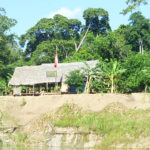
A few months ago, we launched the construction of a fourth checkpoint within the concession. This checkpoint was placed in a strategic location on the Yanayacu River: at the entrance to the Camungo stream. Below the checkpoint, we also placed a floating barrier to prevent poachers from entering the concession.

This month we returned to check the condition of the area. As a result, the checkpoint and the floating fence have been very effective. No poachers were able to get through, and the animals, fish and timber were protected on this side of the concession!

We were also able to talk to the communities near the area who were very excited about this new victory. According to them, the wildlife will be able to reproduce in the absence of poachers! From now on, our teams will continue to monitor the area carefully.

March 2021

Lotty Morey, President of the association, laureate of the Terres de Femmes prize for her commitment to the Amazon

We are very proud to announce that Lotty Morey, President of the Amazon Biodiversity Association, has been awarded the Terres de Femmes prize for her fight to preserve the Amazon forest. The winners of this prize awarded by the Yves Rocher Foundation are women who “work for biodiversity and to change the world”.

A beautiful video is worth a thousand words, so let’s (re-)discover the work of our association, with some magnificent landscapes as a bonus!

February 2021

Accident in the Ampicocha Lagoon

This month we publish an anecdote from the logbook of Lotty Morey, president of the Amazon Biodiversity Association. Because not everything is rosy, we also wanted to share with you some of the difficulties faced by members of the field team. Today, we tell you the story of Ivan, the concession’s main ranger, who faced complications due to bad weather.

Ivan, accompanied by 2 assistants, went to the Romayna Creek to evict hunters and loggers in search of commercial trees that no longer exist outside the concession. There was a big storm, the water in the lake got rough and the boat flipped over with the engine and all the equipment in it. They were then rescued by 3 people from the Florida community located on the shores of the lake. After several dozen minutes, they were able to turn the boat around. They recovered the engine full of water.

Ivan dived several times to try to retrieve his backpack containing his mobile phone, bills, maps and other important items. He was trapped in a space on the boat, which fortunately remained dry.

However, he was unable to retrieve the bag containing important equipment: pliers, keys, spark plugs and other equipment that must be carried on every long journey. The staff escaped with a few bruises, fortunately not serious. However, the engine was unusable. It was repaired a few days later, allowing Ivan to continue to deter poachers from the concession.

January 2020

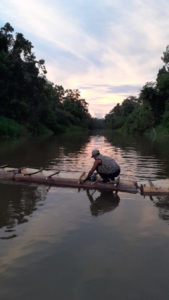
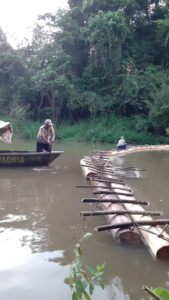
At the beginning of this year, the park warden teams are reinforcing their vigilance tools and setting up floating barriers at the entrances to the reserve, the most coveted of which is undoubtedly located in the Romayna sector.

The Romayna is a breeding ground for arahuana paiche, an endemic fish whose size and price attract many fishermen to this isolated and particularly well-preserved area. The fish grow happily and the paiche sometimes reach more than 1.5m. In this area there are still trees, often centuries old, of species that unfortunately no longer exist outside the reserve. The shihuahuaco and the mahogany are the first victims of this intensive and uncontrolled pruning.

This year the pressure on the area is greater than ever, the country’s economic situation is weakened by the ongoing health crisis and many people in the region are looking for ways to make a living. To date, several park guard expeditions have already taken place to dislodge the offenders, all with success.

November 2020

The future of the forest lies (also) with the younger generation

More than 65 children took part in Steffanny’s afternoon of discovery and relaxation around the theme of conservation. The children of Mahuizo and Santa Lucia were able to share their feelings and their vision of the environments they live in during collective awareness-raising activities in the open air.

From an early age they are aware of the world around them and their interdependence with the biodiversity present. The parents, often hunters, fishermen, farmers or foresters, all live off what the forest offers them. A relationship that sometimes tends to diminish the present resources that are essential for the survival of local communities.

Over the course of several afternoons we were able to laugh and exchange life stories with them, highlighting their relationship with nature. A moment of playful reflection to highlight the richness of the exceptional environment of the reserve and the economic and social interest that its conservation represents for these villages.

October 2020

Raising awareness of conservation

The end of the year is approaching and the rain is coming; an ideal time to raise awareness of the reserve’s conservation and its usefulness in providing resources essential to their well-being.

This month, several activities were proposed to the 4 communities bordering the Concession: discovery of economic alternatives to conservation, debate on the preservation of forest resources, environmental animation for children and visits to plots for farmers aiming to valorise the available resources. A varied programme which reached around 70 adults and 50 children and which notably allowed the planting of 430 endangered trees in schools or on the plots of interested producers: quinilla colorada (Manilkara bidentata) cedro (Cedrela odorata) cumala colorada (Virola sebifera).

Steffanny (forestry engineer) spent a month with them and will return next year to continue the work in a sustainable way.

September 2020

Signposting for better information

The team of park rangers recently renovated the signage at each entrance to the concession, a major effort to make it easier to monitor the area and properly inform offenders.

Armed with paint and a machete, the local team set about the annual renovation of the entry points and boundaries of the concession. This is a repetitive and tedious job that takes place over several days and requires the deployment of a wilderness camp in the middle of the rainforest each evening to spend the night.

This operation, which is essential for monitoring the site, is made compulsory by agreements with the Peruvian government and is an indispensable tool in this area, which is increasingly frequented as the poaching season approaches.

In the coming years, we hope to gradually strengthen the infrastructure to deter potential offenders ever more effectively.